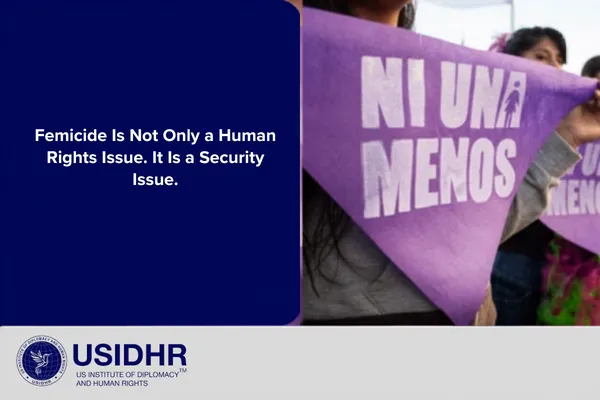
Femicide Is Not Only a Human Rights Issue. It Is a Security Issue.
Policy Commentary | Global Security | Violence Against Women
Key Takeaways
• Femicide should be understood not only as a human rights violation but also as a governance and security challenge.
• Gender-related killings follow patterns distinct from most homicide dynamics and require targeted prevention systems.
• Lessons from Latin America show that legal recognition, institutional capacity, and coordinated policy responses are essential to prevent femicide.
Introduction
Violence against women is widely recognized as one of the most pervasive human rights challenges worldwide. Among its most extreme manifestations is femicide, the gender-related killing of women and girls. Yet the way policymakers frame femicide matters. When treated solely as a human rights or social issue, the broader implications for governance, institutional stability, and public security often remain overlooked.
Drawing on firsthand policy experience during the adoption of the Inter-American Model Law on the Prevention, Punishment and Eradication of the Gender-Related Killing of Women (Femicide/Feminicide) at the Organization of American States in Washington, DC, it became clear to me that the persistence of femicide often reflects deeper weaknesses in governance systems, institutional capacity, and prevention frameworks. These policy discussions highlighted an important reality. Preventing gender-related killings requires not only legal recognition but also effective institutions capable of protecting vulnerable populations.
A Global Policy Challenge
Across regions of the world, violence against women remains widespread. Globally, tens of thousands of women are killed every year because of their gender.[1] Even in regions with relatively low homicide rates, gender-related killings remain a persistent policy challenge.
In the European Union, survey data indicate that one in three women has experienced physical violence, sexual violence, or threats during her lifetime, while Eurostat estimates that 18 women die every week as victims of femicide across the EU.[2][3]
Similar patterns exist in other regions. In the United States, thousands of women are killed every year, many in the context of domestic violence or gender-related violence. Despite legal protections and institutional frameworks designed to prevent violence against women, policymakers continue to confront persistent gaps in prevention, coordination, and early intervention.
International frameworks such as the Council of Europe’s Istanbul Convention and national strategies addressing violence against women represent important progress.[4] The European Commission’s recently presented Gender Equality Strategy 2026–2030, announced ahead of International Women’s Day, further reflects the growing political commitment to addressing gender-based violence.[5] Yet legal commitments alone do not guarantee effective prevention.
Across many countries, gender-related killings continue to be recorded simply as homicide or addressed primarily within domestic violence frameworks. While intimate partner violence remains a central driver of femicide, evidence increasingly shows that gender-related killings can also occur in environments shaped by organized crime, human trafficking networks, armed violence, and institutional weaknesses in prevention systems.
Why Femicide Is Also a Governance and Security Issue
When gender-related killings persist despite legal protections, they reveal deeper institutional vulnerabilities. Failures to identify high-risk cases, gaps in protection mechanisms for victims of violence, weak coordination between law enforcement and social services, and insufficient data collection can all contribute to environments in which violence escalates.
In this sense, femicide functions not only as a human rights violation but also as a governance indicator. Persistent gender-related killings signal whether institutions are capable of preventing violence and protecting the lives of women. When prevention systems fail, the consequences extend beyond individual cases and reveal structural weaknesses within governance and security systems.
Recognizing femicide does not diminish the seriousness of other forms of homicide. Men represent the majority of homicide victims worldwide, and many of these killings are linked to organized crime, gang violence, or other criminal activities. Femicide refers to a different pattern of violence. It describes killings in which women are targeted because of their gender or killed in contexts shaped by gender-based violence, often following patterns such as prior domestic abuse or coercive control. These forms of violence are therefore not mutually exclusive, but they reflect distinct risk factors that require different prevention and policy responses.
Understanding femicide through a governance and security lens does not diminish its human rights dimension. Rather, it expands the policy framework through which these crimes are addressed. When femicide is framed only as a private or domestic form of violence, policy responses often remain limited to criminal justice interventions after violence has already occurred.
Recognizing the governance and security implications of femicide highlights the importance of prevention systems, institutional coordination, and early warning mechanisms capable of identifying high-risk cases before violence escalates.
Lessons from Comparative Policy Experience
Lessons from Latin America illustrate both the possibilities and the limitations of legal reform. Over the past two decades, many countries across the region introduced specialized femicide legislation, investigative protocols, and institutional mechanisms designed to address gender-related killings. These reforms improved legal recognition, strengthened investigative frameworks, and increased data visibility.
At the same time, the persistence of high rates of femicide in several countries demonstrates a critical lesson for policymakers. Criminal law alone cannot prevent gender-related killings. Effective responses require coordinated prevention systems, reliable data collection, institutional accountability, and sustained policy implementation.
These lessons are relevant not only for Europe but also for the United States and other regions confronting similar challenges in preventing violence against women.
As governments continue to strengthen legal frameworks addressing violence against women, the challenge is not only to punish perpetrators but to prevent gender-related killings before they occur. Recognizing femicide as both a human rights issue and a governance challenge is an essential step toward building policies capable of addressing the structural conditions that allow these crimes to persist.
Addressing femicide as both a governance and security challenge requires deeper comparative research and continued dialogue between policymakers, researchers, and international institutions. As governments refine strategies to prevent gender-related killings, evidence-based policy analysis and cross-regional learning will be essential for designing effective prevention systems and strengthening institutional responses.
The analysis presented here draws on the policy brief Femicide as a Global Security Threat: Policy Lessons from Latin America for Europe, which examines how comparative policy experiences can inform responses to gender-related killings.
The full policy brief is available here:
https://usidhr.org/publications/femicideeu
References
[1] United Nations Office on Drugs and Crime (UNODC) and United Nations Entity for Gender Equality and the Empowerment of Women (UN Women). 2024. Femicides in 2023: Global Estimates of Intimate Partner/Family Member Femicides. Vienna and New York: UNODC and UN Women.
[2] European Union Agency for Fundamental Rights (FRA) and European Institute for Gender Equality (EIGE). 2026. Violence against Women Survey Results Across the European Union. Luxembourg: Publications Office of the European Union.
[3] Eurostat. 2026. Gender-Related Killings of Women and Girls in the European Union. Luxembourg: European Commission.
[4] Council of Europe. 2011. Council of Europe Convention on Preventing and Combating Violence against Women and Domestic Violence (Istanbul Convention). CETS No. 210. Istanbul.
[5] European Commission. 2026. Gender Equality Strategy 2026–2030: A Union of Equality for a More Equal, Cohesive and Successful Europe. Brussels: European Commission.