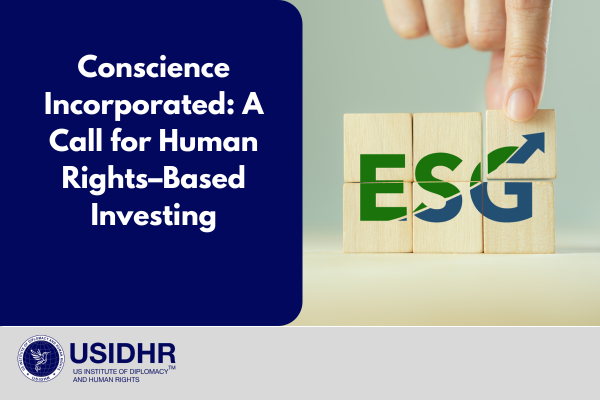
Conscience Incorporated: A Call for Human Rights–Based Investing
Conscience Incorporated calls for a transformation in how businesses approach human rights, urging companies to go beyond surface-level ESG commitments and embrace reforms that align profit with ethical responsibility.
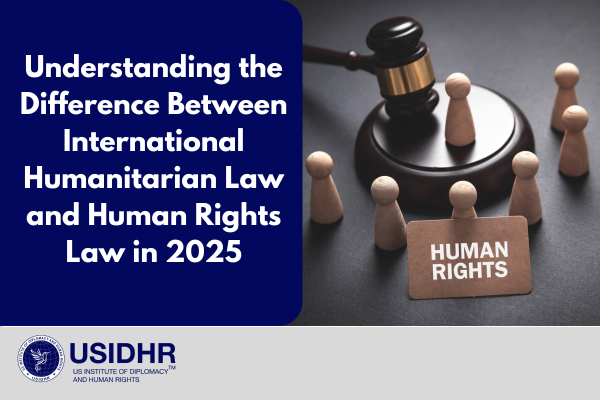
Understanding the Difference Between International Humanitarian Law and Human Rights Law in 2025
This article distinguishes International Humanitarian Law (for armed conflicts) from Human Rights Law (applies always), using the 2025 Russia-Ukraine prisoner exchange to show how both frameworks protect human dignity.

Human Rights Due Diligence: The Key to Sustainable and Ethical Business Practices
This article explains the importance of Human Rights Due Diligence (HRDD) in business, covering compliance, risk management, and ESG benefits with USIDHR’s support.
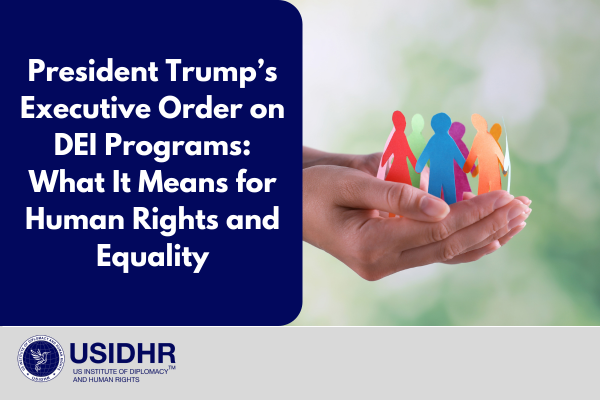
President Trump’s Executive Order on DEI Programs: What It Means for Human Rights and Equality
President Trump’s executive order on DEI programs sparks debate on human rights and equality. Are universal principles enough without DEI initiatives?
How Covenantal Pluralism Can Transform Global Human Rights Practices
In an increasingly interconnected world, the pursuit of universal human rights is often hindered by cultural, religious, and ideological divides. Covenantal Pluralism offers a transformative framework to bridge these divides.
How to Become a U.S. Diplomat: Guide to the Foreign Service Exam
Embarking on a career as a U.S. diplomat is a noble and challenging path that starts with passing the Foreign Service Exam. This rigorous examination is your
The Role of Protocol in Modern Diplomacy
The Role of Protocol in Modern Diplomacy
Diplomatic protocol plays a crucial role in fostering respectful and effective international relations.
The Significance of Juneteenth: Celebrating Freedom and Honoring History
The Significance of Juneteenth: Celebrating Freedom and Honoring History 5 min read Why is Juneteenth Important? Juneteenth, also known as Emancipation Day, Freedom Day...
The Universal Declaration of Human Rights vs. the US Constitution: What You Need to Know
The Universal Declaration of Human Rights vs. the US Constitution: What You Need to Know 4 min read The Universal Declaration of Human Rights, adopted
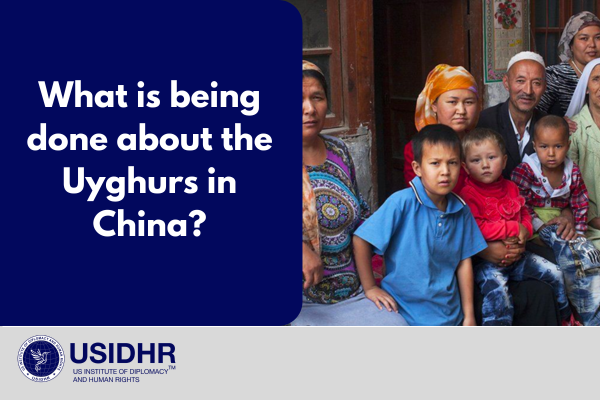
What is being done about the Uyghurs in China?
What is being done about the Uyghurs in China? 7 min read In a modern-day colonial project, the Chinese government is committing genocide and
Addressing Human Trafficking
in Ukraine
Addressing Human Trafficking in Ukraine 7 min read As the conflict between Russia and Ukraine rages on, increased displacement makes millions of individuals vulnerable
What is Digital Citizenship and Why is it Important?
What is Digital Citizenship and Why is it Important? 7 min read The Covid-19 pandemic led to business and school closures which increased technology use
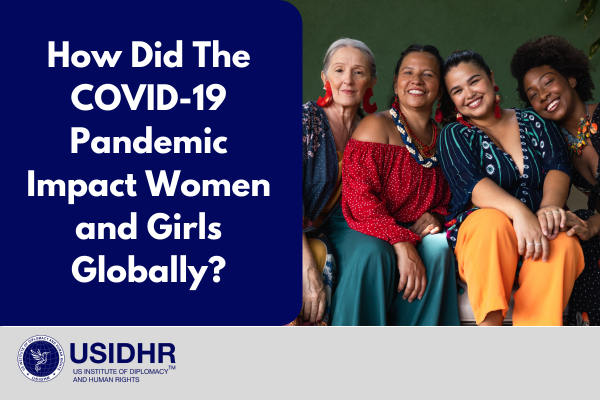
How Did the Global COVID-19 Pandemic Impact Women and Girls?
How Did The COVID-19 Pandemic Impact Women and Girls Globally? 7 min read Despite significant strides in female empowerment, women are often casualties of health
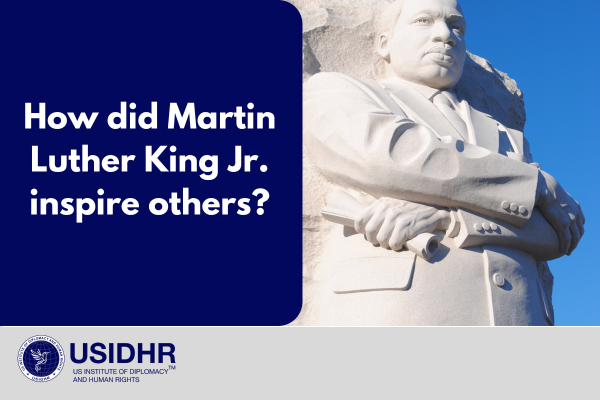
How did Martin Luther King Jr. inspire others?
How did Martin Luther King Jr. inspire others? 7 min read Martin Luther King Jr. is perhaps one of the most prolific figures of our
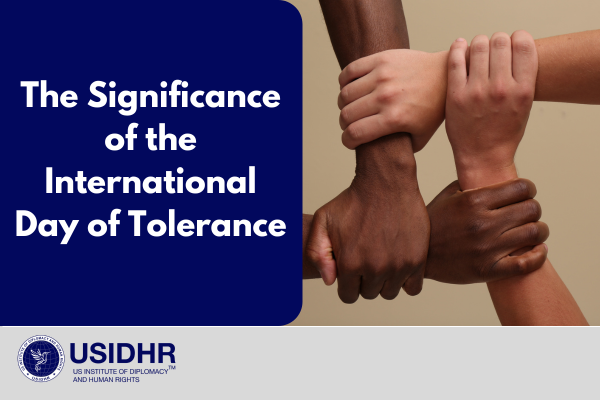
The Significance of the International Day of Tolerance
The word “tolerance” may seem like it became cliché or overused. What is somewhat unbeknownst of tolerance is the power it truly holds.
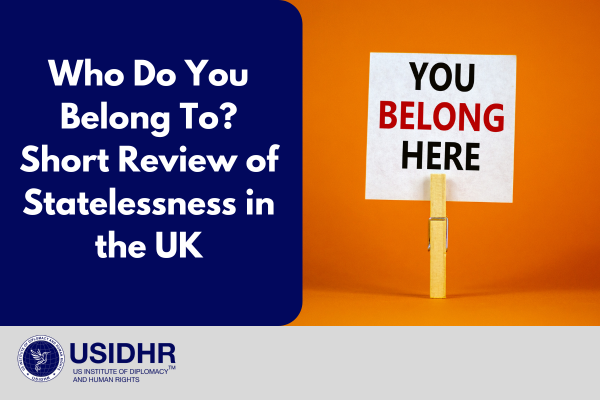
Who Do You Belong To? Short Review of Statelessness in the UK
Share on facebook Share on twitter Share on linkedin Under Article 15 of the Universal Declaration of Human Rights, everyone has a right to ...
Tackling Violence Against Women in The Northern Triangle of Central America (NTCA)
The Northern Triangle of Central America (NTCA) is considered the most violent region in the world. Countries such as El Salvador, Honduras, and Guatemala have some of the highest homicide rates globally.
Roma and Sinti Statelessness
in Germany
What is Statelessness? Article 15 of the UN Declaration of Human Rights states that every person has the right to a nationality, that no one shall be arbitrarily deprived of a nationality, nor denied the right...
Addressing Climate Refugees and Displacement Involving Island Nations
Climate change – and climate displacement – are not merely threats of the future, but are already part of life for the inhabitants of drowning or sinking island nations now (though they are projected to become....
Human Trafficking: A Foundational Cheat Sheet
Picture Credits: Kindel Media Human trafficking is one of the hardest crimes to both detect and prosecute. John Vanek, author, and consultant on the collaborative

A Brief History of Human Rights Documents Throughout Time
How did human rights come about? A Brief History Overtime 12 min read It was only 100 years ago that in the
What is the most violated Human Right in America?
Picture: Jenny Chiang (front left), Jessica Wong (center), and Sheila Vo (front right) of Massachusetts’s Asian American Commission at a protest in front of the

What is the importance of human rights to law enforcement?
“In the performance of their duty, law enforcement officials shall respect and protect human dignity and maintain and uphold the human rights of all persons.”
What are the 6 types of slavery?
Image credit: Travis Saylor Slavery. A term you have probably heard of and is often associated with the past, however, this violation of human right
How do we monitor human rights violations worldwide?
Image credit: Blogtrepreneur As enshrined in the Universal Declaration of Human Rights (1948), we are all entitled to human rights which protect our freedoms and
What is meant by Open Diplomacy?
Open diplomacy is not intended to be a substitution for traditional diplomacy. Open diplomacy is nongovernmental, informal, and involves unofficial interactions and
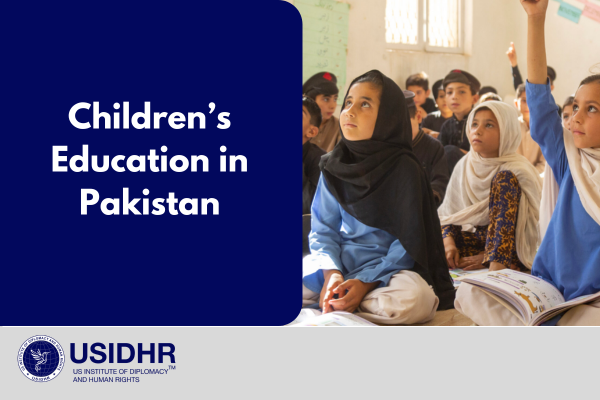
Children’s Education in Pakistan
Image by David Mark from Pixabay The significance of children receiving primary education is extremely underrated. In order for young people to move forwards in
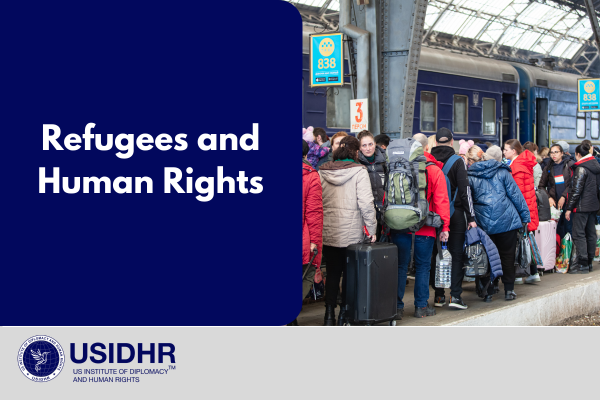
Refugees and Human Rights
Image credit: Marco Verch What do Albert Einstein, Jackie Chan, and the Dalai Lama all have in common? The answer: They were all refugees. Sadly
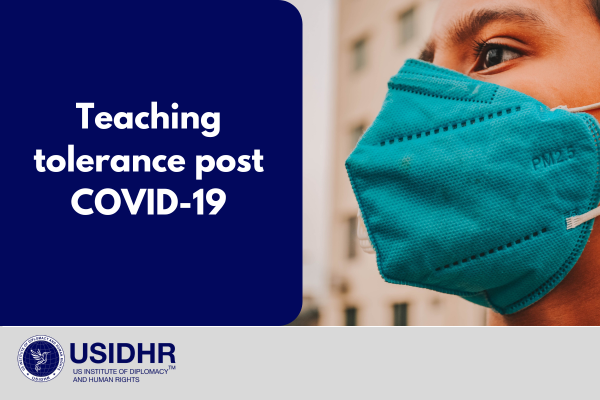
Teaching tolerance post Covid-19
Image credit: 김컴맹딸 The rise of Covid-19 has also resulted in the rise of hate crimes against certain ethnic groups and members of society. False

What is Cloud Diplomacy?
Diplomacy changed considerably during the twentieth century. The word ‘diplomacy’ strictly described any face-to-face contact between the governments of one nation

How to Work in Human Rights
Human rights movements are extremely popular today, and many are somewhat familiar with these two words; whether you’ve heard them at home, with your friends,
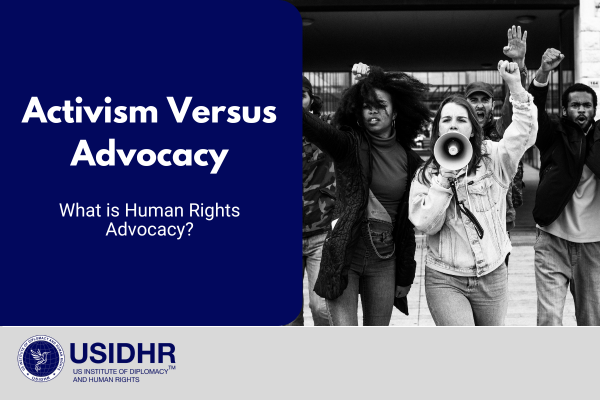
Activism Versus Advocacy: What is Human Rights Advocacy?
From our training sessions and working within our student community, we have found that there is a common misconception regarding the terms activist and advocate.
Can We Reclaim the Night?
Violence against women is worryingly normalized, to the extent that women are being conditioned to protect themselves using anything at their disposal from a very
Human Rights vs Civil Rights
Human rights and Civil Rights. Two key terms within the sphere of diplomacy and development which you have probably heard of, but what do they
Youth-Led Diplomacy in International Organizations
What is youth-led diplomacy? As a young advocate for women’s rights, I’ve recently invested more time in understanding how I can do my part to
Education for children – Advocating for the right to education
The right to education has been recognized as a human right in a number of international conventions, including the International Covenant on Economic, Social and
Women’s Participation in Diplomacy
Diplomacy is the art of dealing with people in a sensitive and effective way. Despite the purpose that diplomacy carries, advocating equal rights for all, the
How Can Youth Get Involved In Diplomacy?
Firstly, I think it is very important to understand the meaning of diplomacy. Diplomacy: the art and practice of conducting negotiations between nations; skill in handling
Bridging the Gap Between Rhetoric and Reality: How Covenantal Pluralism Can Transform Global Human Rights Practices
Introduction
In an increasingly interconnected world, the pursuit of universal human rights is often hindered by cultural, religious, and ideological divides. Covenantal Pluralism, a concept developed by the Templeton Religion Trust, offers a transformative framework to bridge these divides. Rooted in a commitment to mutual respect, equal rights, and reciprocal engagement, covenantal pluralism seeks to foster societies where individuals and communities thrive in their differences, while upholding shared values and responsibilities.
Despite the unequivocal language of international human rights instruments like the Universal Declaration of Human Rights (UDHR)[1], a significant gap exists between the lofty rhetoric of human rights and their implementation in practice. States often publicly endorse human rights while simultaneously tolerating, rationalizing, or even perpetrating abuses. This dichotomy reflects both the complexity of cultural and political contexts and the challenges inherent in achieving universal interpretations of human rights principles.
This white paper explores how covenantal pluralism can bridge this gap and advance international human rights by addressing key challenges in global and workplace contexts. By creating environments where every individual feels a sense of belonging, starting with respect for their faith and beliefs, we can lay the foundation for a more inclusive and equitable global society.
Background
Covenantal pluralism, as outlined in the Covenantal Pluralism Initiative launched by the Templeton Religion Trust in 2019 [2], provides a holistic approach to fostering mutual respect and engagement across diverse communities. Unlike a purely contractual approach to pluralism—characterized by conditional relationships governed by rules—covenantal pluralism emphasizes enduring relationships that balance rules with grace [3]. This model seeks to create a deeper moral framework that can sustain meaningful engagement even amidst conflicts or differences.
Key Features of Covenantal Pluralism:
Equal Rights and Responsibilities: A constitutional order that guarantees freedom of religion and conscience while ensuring equal treatment of all beliefs and worldviews. This foundational principle aligns with Article 18 of the UDHR and the International Covenant on Civil and Political Rights (ICCPR) [4].
Relational Engagement: Covenantal pluralism prioritizes relationships over mere coexistence. It encourages spirited, meaningful interactions between diverse groups, moving beyond indifferent tolerance to a genuine engagement that values mutual understanding.
Inclusion with Accountability: While inclusive, covenantal pluralism demands respect for shared norms, such as fairness for all and the right to individual autonomy, including opting out of communities without fear of violence.
Enabling Conditions: To cultivate a pluralistic society, three key conditions must be met:
Freedom of Religion and Belief: Recognizing the universal human impulse to seek transcendence and protecting this freedom from systemic repression or discrimination.
Religious Literacy: Developing a deep, cross-cultural understanding of one’s own beliefs, those of others, and the dynamics of multi-faith engagement. This transcends superficial knowledge to foster empathy and nuanced dialogue.
Virtues of Pluralism: Cultivating traits such as humility, patience, empathy, and courage to navigate deep and sometimes irreconcilable differences.
Framing pluralism in covenantal terms is especially relevant in a global context, where many cultures lean toward communitarian values. This model of pluralism welcomes diverse participants, from secular to religious and fundamentalist to modernist, fostering a broad, inclusive dialogue that acknowledges exclusive truth claims while promoting mutual respect.
Proposed Solution
Education is the cornerstone of change and the foundation upon which covenantal pluralism can be realized. As César Chávez aptly stated, "You cannot uneducate the person who has learned how to read." However, global literacy rates, particularly regarding religious and multi-faith literacy, remain alarmingly low. Many governments, especially those striving to be removed from the Countries of Particular Concern (CPC) list established by the U.S. Department of State [5], often focus their efforts on teaching human rights and religious freedom at universities and graduate schools. While important, such efforts fail to address the broader need for education at all levels of society.
True education must begin earlier and extend far beyond the classroom. It needs to permeate workplaces, public spaces, and even daily interactions. Educational initiatives can include training programs in human rights, religious literacy, and covenantal pluralism, ensuring inclusivity and fostering environments where everyone feels they belong.
To illustrate this transformative power of education, consider the shift in social identity observed when Romania entered the European Union. In a study from a few years ago, called "The Influence of the Emergence of the European Union on the Social Identity of Citizens of Member States and Outsiders", I explored how Romanians began identifying themselves as European citizens, transcending national boundaries. This shift aligns with Social Identity Theory [6], which explains how group membership influences self-image and interactions with outsiders.
Building a similar collective identity around shared human rights and pluralism requires education that reaches everyone—not only in schools but also in workplaces, bus stations, and other communal spaces. Posters, public campaigns, and grassroots initiatives can complement formal education, embedding the principles of covenantal pluralism into everyday life. Below, we explore how these ideas can address real-world challenges and provide actionable solutions.
Covenantal pluralism offers a transformative approach to addressing some of the most pressing human rights challenges. By emphasizing education and capacity-building, it equips individuals, communities, and institutions to navigate differences constructively, fostering inclusive environments and respect for diverse beliefs. Below, we explore key real-world challenges and actionable solutions grounded in the principles of covenantal pluralism.
Real-World Challenges and Solutions
1. Faith in the Workplace
Problem: In many workplaces, individuals face discrimination or exclusion based on their religious beliefs. Microaggressions, lack of accommodations, and proselytizing behaviors create environments of division and discomfort.
Solution:Education is the foundation of change. Through targeted education and capacity-building initiatives, workplaces can foster respect for diverse beliefs and create environments where employees feel valued. Training programs in human rights, covenantal pluralism, and religious literacy equip employees and management with the tools to engage in open dialogue, accommodate religious practices, and respect differences. For instance, prayer rooms and flexible scheduling policies can be implemented as tangible steps toward inclusion.
2. Polarization in Society
Problem: Deep cultural and religious divides often result in societal conflicts and exclusion. Minority groups frequently face systemic discrimination and are denied equal opportunities.
Solution: Promoting education-driven community programs that enhance religious literacy and foster interfaith dialogue can bridge societal divides. By teaching the values of covenantal pluralism, these initiatives empower communities to navigate differences constructively, ensuring minority groups are included and valued. Public campaigns highlighting the shared benefits of pluralistic societies can further reduce polarization.
3. Global Refugee Crisis
Problem: Refugees fleeing persecution often face compounded discrimination in host countries due to their religious or cultural identities.
Solution: Capacity-building programs for both refugees and host communities can address these challenges. Providing refugees with religious literacy training alongside vocational education helps them integrate while respecting their identities. Simultaneously, educating host communities about the contributions and rights of refugees fosters mutual respect and reduces prejudice. Policies reflecting covenantal pluralism principles ensure equitable treatment for all.
Steps to Implementation
Education and Training: Develop programs that teach covenantal pluralism, emphasizing religious literacy, empathy, and legal protections.
Policy Advocacy: Partner with governments and international organizations to promote laws that uphold freedom of religion and belief.
Community Engagement: Support grassroots initiatives that foster interfaith dialogue and collaborative problem-solving.
Global Networks: Build coalitions of advocates who champion covenantal pluralism in their regions, sharing best practices and resources.
Conclusion
Covenantal pluralism provides a powerful framework to advance international human rights by addressing the foundational need for belonging and mutual respect. By starting with faith—a deeply personal and universal aspect of identity—we can create societies where diversity is celebrated, and human rights are realized for all.The US Institute of Diplomacy and Human Rights is committed to championing this vision through expert-led training, advocacy, and collaboration. Together, we can build a world where every individual, regardless of belief, feels seen, respected, and empowered to thrive.
Reference list
[1] Universal Declaration of Human Rights. (1948). United Nations.
[2] Templeton Religion Trust. "Covenantal Pluralism Initiative." 2019.
[3] Stewart, W. Christopher, Chris Seiple, and Dennis R. Hoover. "To Advance International Human Rights, First Promote Covenantal Pluralism." LSE Religion and Global Society Blog, December 16, 2020. https://blogs.lse.ac.uk/religionglobalsociety/2020/12/to-advance-international-human-rights-first-promote-covenantal-pluralism/#comments.
[4] International Covenant on Civil and Political Rights. (1966). United Nations.
[5] U.S. Department of State. "Countries of Particular Concern, Special Watch List Countries, Entities of Particular Concern." Office of International Religious Freedom. Accessed [Insert Date]. https://www.state.gov/countries-of-particular-concern-special-watch-list-countries-entities-of-particular-concern/.
[6] Tajfel, Henri, and John Turner. "The Social Identity Theory of Intergroup Behavior." In Psychology of Intergroup Relations, edited by Stephen Worchel and William G. Austin, 7-24. Chicago: Nelson-Hall, 1986.

The US Institute of Diplomacy and Human Rights (USIDHR) is an International Continuing Professional Development (CPD) Accredited Organization. Accredited CPD training means the learning activity has reached the required Continuing Professional Development standards and benchmarks. The learning value has been scrutinized to ensure integrity and quality. The CPD Certification Service provides recognized independent CPD accreditation compatible with global CPD requirements
US Institute Of Diplomacy And Human Rights
1250 Connecticut Ave NW Ste 700-5274, Washington, DC 20036




© 2026 US Institute of Diplomacy and Human Rights is a 501(c)(3) organization. Gifts are deductible to the full extent allowable under IRS regulations.